
Melissa had both hands wrapped around the handle of her largest suitcase before I had even opened the front door all the way.
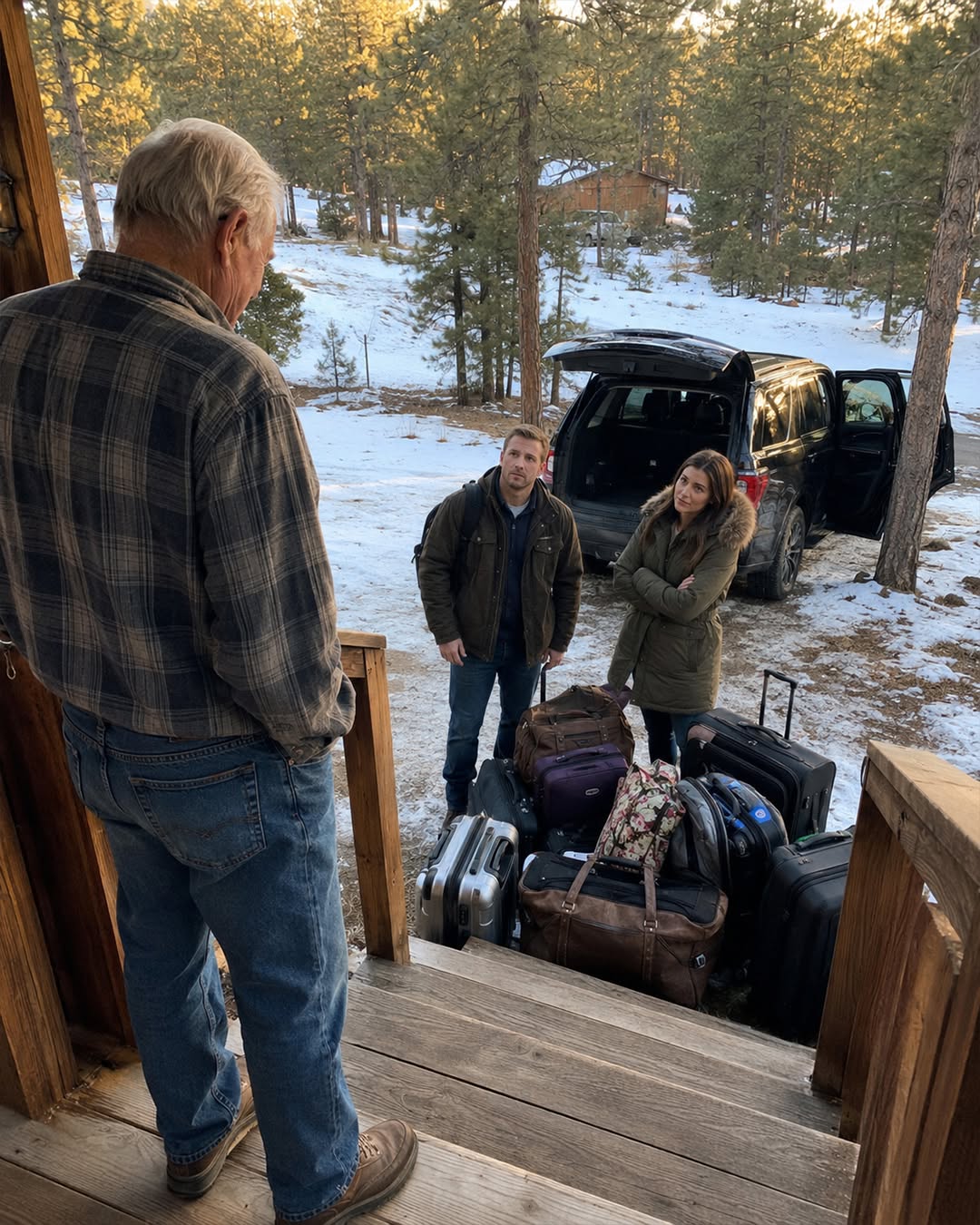
That was the first thing I noticed. Not her smile, though it was wider than any smile she had given me in nearly seven years. Not my son Daniel standing behind her with his shoulders hunched inside an expensive charcoal coat, looking at the porch boards instead of at me. Not the black SUV idling in my gravel driveway with its back hatch raised and a stack of luggage waiting like they had checked out of one life and chosen mine without asking.
No, what I noticed was Melissa’s hand on the suitcase.
She already believed she had a right to carry it in.
“Harold,” she said brightly, as if we had spoken every Sunday for years instead of sending each other holiday cards that arrived late and said almost nothing. “Surprise.”
Behind her, Daniel gave me a small, careful smile. “Hi, Dad.”
The December air moved between us, cold and clean, smelling of pine needles and wood smoke. Snow clung to the roof of the cabin, softening the edges of the porch and settling in the iron lanterns beside the door. From where I stood, I could see the mountain ridge beyond the trees, blue in the late afternoon light. It was the kind of view that made strangers lower their voices.
Melissa did not lower hers.
“We heard the wonderful news,” she said. “I mean, Daniel told me not to make a big deal of it, but honestly, how could we not? Your place is beautiful, Harold. Absolutely beautiful.”
I looked past her at the SUV. There were six suitcases, two plastic storage bins, a dog crate, and a rolled-up rug sticking out from behind the third row.
“Looks like you packed for more than dinner,” I said.
She laughed, the quick polished laugh she used when she wanted a sentence to disappear before anyone could examine it. “Well, life is short. We’ve been apart too long. Daniel and I talked, and we decided it’s time to rebuild. Really rebuild.”
Daniel rubbed one hand across the back of his neck. He was forty-two, but in that moment he looked sixteen again, caught between what he knew was right and what he was allowing anyway.
“Dad,” he said quietly, “families should be together.”
The line sat there between us, neat and rehearsed.
I had imagined many versions of this moment over the years. My son showing up because he missed me. My daughter-in-law calling because she had realized silence can become a kind of message. My grandchildren asking why they had not visited the man who made their first rocking horse and built the treehouse they outgrew before they thanked him properly. I had imagined anger, apology, awkwardness, even tears.
I had not imagined luggage.
But I had known something was coming.
The calls had started ten days earlier. First Daniel, three times in one afternoon. Then Melissa, texting little sunshine phrases as if she had discovered cheerfulness in a sale bin. Hope you’re doing well, Harold! We should catch up soon! The cabin looks amazing! Then my nephew in Phoenix, who had not called since my wife’s memorial, wanted to know how retirement was treating me. Then a cousin asked whether I was “still up in Aspen,” though I had never lived in Aspen and had corrected that detail twice.
The final clue came from my neighbor Ruth, who brought over a loaf of banana bread and her phone.
“You should see this,” she said, holding the screen out to me in my workshop.
Someone in the family had shared a photo of my cabin taken from a flattering angle after fresh snow, the mountain ridge glowing behind it. The caption said I had purchased a private mountain estate and was “finally living like a king.” A few cousins had commented with little house icons and surprised faces. Someone else had written, Guess Harold was quiet for a reason.
I had laughed then, not because it was funny, but because people reveal themselves so quickly when they think a door has opened.
My cabin was not an estate. It was a weathered, well-built place at the edge of a mountain town where people still waved from pickup trucks and left casseroles on porches without needing credit. It had a big great room because the previous owner used to host community suppers. It had a wide front porch because mountain storms teach people to build with overhangs. It had a view because land that far from town came cheaper if you were willing to plow your own driveway and fix your own pipes.
I had bought it after selling the little house I shared with my wife, Margaret.
Margaret had been gone seven years by then, and for seven years I had moved through our old rooms like a man trying not to disturb ghosts. Her blue mug stayed in the cabinet. Her gardening gloves hung by the back door. Her reading glasses remained on the nightstand beside a paperback with a receipt tucked between pages. At first, I left everything because grief made any change feel like disloyalty. Later, I left everything because Daniel never came by long enough to help me decide what to do with it.
After the memorial, people had filled the house for two days. They brought food, folded chairs, flowers, stories. Daniel held my shoulder by the fireplace and said, “We’re here, Dad. You won’t be alone.”
I believed him because fathers are not immune to hoping their children mean what they say.
But life narrowed. His calls shortened. His visits became holiday obligations that kept getting postponed. Melissa said the kids had school, activities, allergies, travel conflicts, winter schedules, summer schedules, anything that sounded organized enough to be believed. Birthdays became texts. Father’s Day became a card signed by everyone in the same pen, likely at the kitchen island while someone was looking for stamps.
The neighbors checked on me more than my family did.
Ruth brought soup. Ben from the hardware store asked if my snowblower was holding up. A high school shop teacher named Luis stopped by one Saturday to borrow clamps and stayed three hours talking about students who needed mentors. Slowly, my empty garage filled with wood again. Then toys. Then chairs. Then shelves. Then requests from people who knew someone who needed a table, a crib, a ramp, a repaired dresser, a little dignity built from pine and patience.
That was how the cabin began to matter.
Not because it looked expensive from a certain angle.
Because inside it, people were trying to become useful to one another.
Melissa shifted on the porch, pulling me back to the present. “It’s freezing. Should we bring these in?”
She was already leaning toward the doorway.
I looked at Daniel. “You came to move in?”
SEE NEXT PAGE >>>
To see the full cooking instructions, go to the next page or click the Open button (>) and don't forget to SHARE it with your friends on Facebook.