

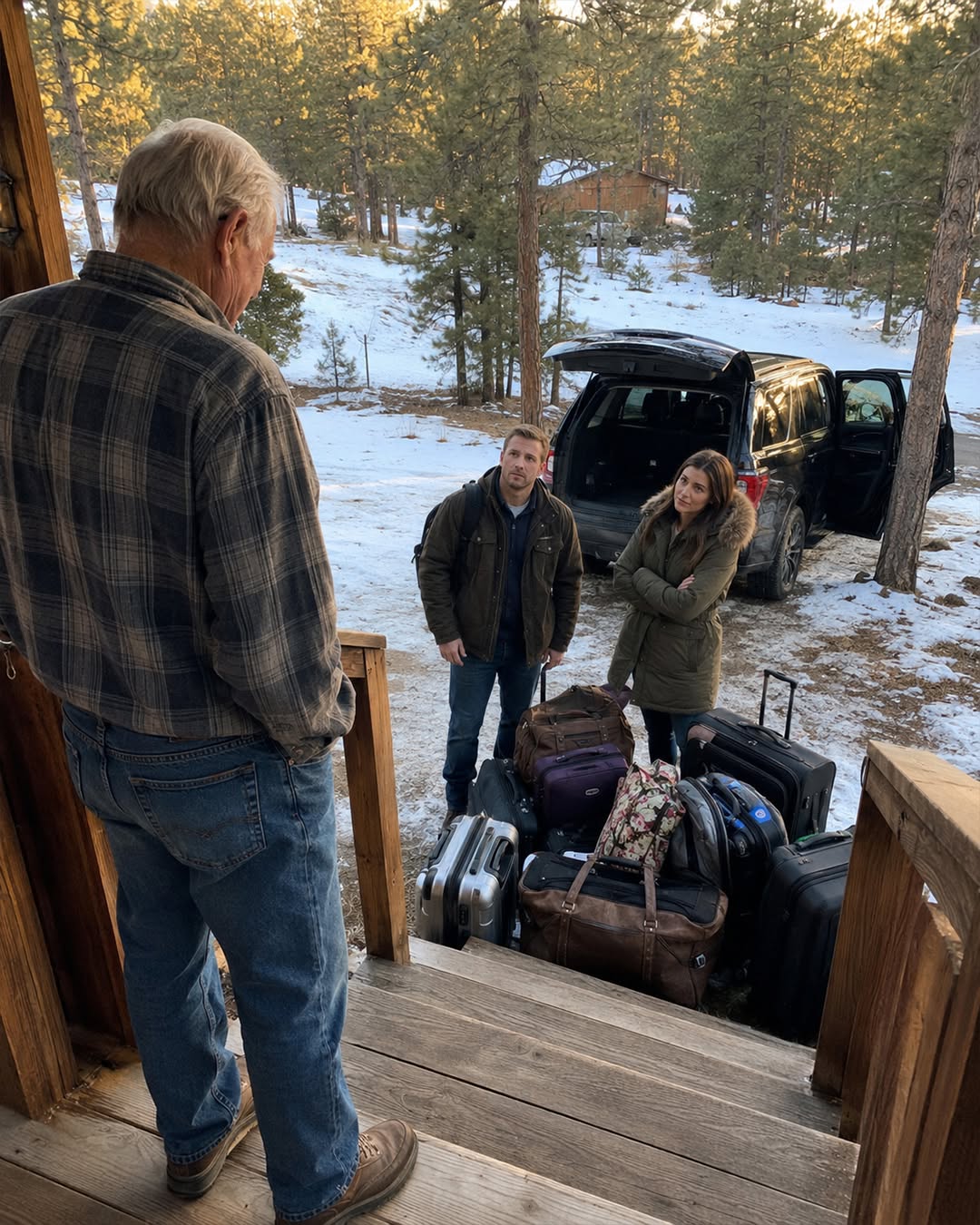
His eyes flicked toward Melissa, then back to me. “Maybe not permanently. We thought we’d stay a while. Talk. Figure things out.”
“How long is a while?”
Melissa answered before he could. “We’ll see what makes sense. Honestly, Harold, this place is huge. And Daniel has been worried about you being alone up here. It just feels natural. Family under one roof.”
Family under one roof.
That phrase would have meant something to me years ago. It might have undone me after Margaret passed, when I still set two plates by accident and woke before dawn reaching for a hand that was no longer there. Back then, if Daniel had asked me to come live with them, I might have sold everything and gone. I might have folded myself into a guest room, learned Melissa’s rules, and called it love.
But loneliness, if you survive it long enough, teaches you the shape of your own soul.
I stepped aside.
“Come in,” I said.
Melissa’s smile flashed with victory.
Behind her, Daniel exhaled as if a difficult conversation had been avoided. That was my son’s habit. He mistook delay for peace.
They carried the luggage across the threshold.
I let them.
The great room stopped them cold.
It was not the room they had expected. I knew that before Melissa’s suitcase wheels clicked over the first seam in the wide plank floor. The photographs online had shown the stone fireplace, the tall windows, the vaulted ceiling, the mountain light pouring through the glass. Cropped correctly, the room looked like a luxury retreat. People saw what they wanted to see.
They did not see the truth beyond the frame.
Along the left wall were workbenches, three of them, each scarred with saw marks and pencil lines. Sandpaper, clamps, hand planes, and jars of screws sat in neat rows. Half-finished wooden chairs leaned upside down on a drop cloth. Near the fireplace, shelves held handmade toys: trains, puzzle boxes, little rocking horses, blocks rubbed smooth enough for a toddler’s hands. Against the far wall, donated books filled old crates I had turned into shelves. Blankets were folded in tall stacks beside labeled bins: winter socks, pantry staples, school supplies, household basics.
A long table dominated the center of the room. Not polished walnut. Not designer. A plain sturdy table I had built myself, wide enough for people to sit shoulder to shoulder while they sorted donations, shared coffee, signed up for projects, or cried quietly into napkins when life had finally become too heavy to carry alone.
Melissa’s smile disappeared inch by inch.
Daniel’s hand tightened around the handle of his duffel bag.
The dog in the crate whimpered softly from the porch.
Melissa looked up at the beams, then at the benches, then at the bins. “Where is everything?”
I closed the door behind them. “Everything is here.”
“No, I mean…” She lowered her voice, though there was no one else in the room yet. “The furniture. The art. The rooms.”
“The cabin has rooms.”
“Luxury rooms.”
I looked at Daniel. “Is that what you thought?”
He did not answer.
Melissa set her suitcase upright with more force than necessary. “The pictures made it look like…”
“Like I had money,” I finished.
The room went quiet except for the old wall clock ticking above the fireplace.
I had built that clock the winter after Margaret passed. The face was plain maple, the numbers burned by hand, the pendulum made from a piece of walnut she had saved for a shelf we never got around to making. For seven years, it had measured the hours of a life I had not expected to rebuild.
Melissa folded her arms. “People said this place was worth a fortune.”
“People say many things when they don’t ask the person living the truth.”
Daniel finally spoke. “Dad, we didn’t come because of money.”
I watched his face carefully. He wanted that sentence to be true. Wanting is not the same as truth.
“No?” I asked.
His eyes moved to the bins. To the unfinished chairs. To the donation board near the kitchen, where I had written Saturday Build Day in blue marker.
Melissa noticed the board too. “What is all this?”
“This cabin is a workshop,” I said. “And a gathering place. Weekends, mostly. Sometimes evenings. We build furniture for families starting over. Repair what can be repaired. Collect supplies. Teach skills. Feed whoever is here. Nothing fancy.”
Melissa stared at me as if I had described a business mistake.
“You turned this whole place into a community center?”
“No,” I said. “The community turned it into a home.”
She did not know what to do with that.
Daniel walked toward the shelves and picked up a small wooden truck. He turned it over in his hands. I had sanded it the night before, leaving it unfinished so a group of teenagers could paint it on Saturday. His thumb moved over the wheel peg.
“You made these?”
“Some. Others were made by volunteers. Kids from Luis’s shop class help. Ruth paints details. Ben donates scrap lumber when he can.”
Daniel set the truck down gently.
For a second, I saw him at eight years old in my garage, wearing safety goggles too big for his face, asking if he could hammer “just one nail.” Margaret had stood in the doorway laughing, warning us not to teach him bad habits unless we planned to keep him. I had taught him anyway. A father always thinks there will be time to teach the rest later.
Melissa’s phone buzzed.
SEE NEXT PAGE >>>
To see the full cooking instructions, go to the next page or click the Open button (>) and don't forget to SHARE it with your friends on Facebook.