
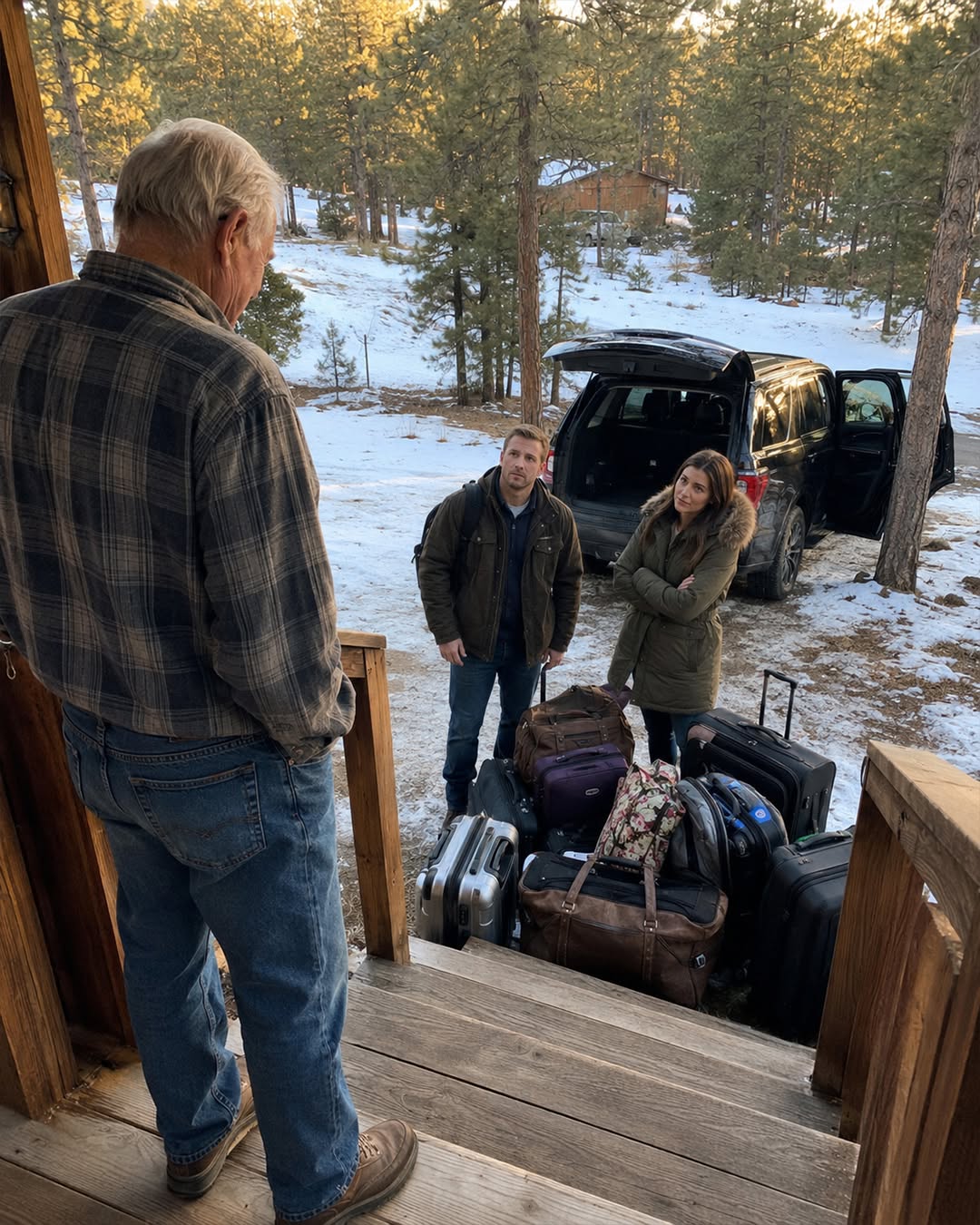
He looked at me then, really looked, and I saw both the boy I raised and the man who had failed me. Both were true. Love does not erase accountability. Accountability does not erase love.
“I want to,” he said.
The honesty of that answer reached me more than a polished promise would have.
Inside, the door opened. Melissa stepped out holding two mugs of coffee, one in each hand. She gave one to Daniel, then stood awkwardly with the other.
“I made you a cup,” she said to me. “Black, right?”
I accepted it.
She looked out at the driveway, at the luggage, at the dark shape of the SUV. “I behaved badly today.”
Daniel glanced at her.
She did not look at him.
“I saw a picture and made a story around it,” she continued. “A convenient story. One where coming here made us look caring and solved things for us at the same time.”
The steam from the mug rose between us.
“I also talked about your home as if it was an opportunity instead of your life. I’m sorry.”
It was not a full transformation. People do not become new between lunch and dinner. But it was a clean sentence. No if. No but. No decoration.
“Thank you,” I said.
She nodded, swallowing. “I don’t know how to help here.”
“Most people don’t when they start.”
“What do I do tomorrow?”
“There are food boxes to pack. Bedding to fold. A donation receipt spreadsheet nobody wants to touch.”
She gave a small, almost real laugh. “I can do spreadsheets.”
“I suspected.”
Daniel smiled into his coffee.
For the first time in years, the three of us stood together without pretending the missing years had been harmless.
The weekend did not fix everything.
It did something better. It revealed what fixing would require.
The next morning, Melissa worked at the kitchen island with Ruth, labeling receipts and organizing supply records. She asked questions. Real ones. Not leading, not performative. Daniel drove with Ben to deliver the newly built table to Claire’s apartment. When he came back, his eyes were red from cold and something else.
“She cried when she saw it,” he told me quietly.
“People cry when a need becomes visible and someone meets it.”
He nodded. “I think I’ve spent years not seeing needs.”
“That can change.”
“Can it?”
“If you let it cost you.”
He understood.
On Sunday evening, they packed most of the suitcases back into the SUV. Melissa did not argue. Daniel carried the dog crate himself. The storage bins never left the vehicle. Before they drove away, my son stood in the driveway and looked back at the cabin.
“I thought I was coming to see what you had,” he said.
“And?”
He looked at the windows glowing gold against the snow. Inside, volunteers were stacking chairs, laughing, sweeping sawdust, wrapping wooden toys in brown paper for children whose names they might never know.
“I found out who you are,” he said.
I did not answer right away.
For years, I had wanted my son to see me. Not as a retired carpenter. Not as a widower. Not as a possible inheritance or a lonely old man in need of management. Just me. Harold. A man who had loved one woman deeply, raised one son imperfectly but sincerely, worked with his hands, lost more than he admitted, and still found a way to build something useful from what remained.
Melissa stepped forward. “May we come back next month? To help. Not to stay.”
I looked at Daniel.
He waited without pushing.
That mattered most.
“Yes,” I said. “Next month.”
They came back in January.
Then February.
By spring, Daniel knew where the clamps belonged and stopped calling every practical task “helping Dad” as if the project existed for my benefit. Melissa rebuilt the donation system, created sign-up forms, and quietly arranged for three local businesses to contribute supplies. She was still particular. Still polished. Still sometimes too certain. But certainty, when placed in service of something larger than comfort, can become useful.
My grandchildren came that summer.
My grandson Tyler, fourteen, asked why so many people had their names written on the beams inside the workshop. I told him each name belonged to someone who had built something here or received something built here.
He ran his fingers over the names.
“Can I add mine?”
“After you build something.”
He spent two days making a crooked bookshelf. It wobbled until Daniel helped him square the frame. When they finished, Tyler burned his name into the underside and asked where the shelf would go.
“To a reading corner at the youth center,” I said.
He grinned. “So some kid will use it?”
“That’s the idea.”
SEE NEXT PAGE >>>
To see the full cooking instructions, go to the next page or click the Open button (>) and don't forget to SHARE it with your friends on Facebook.