
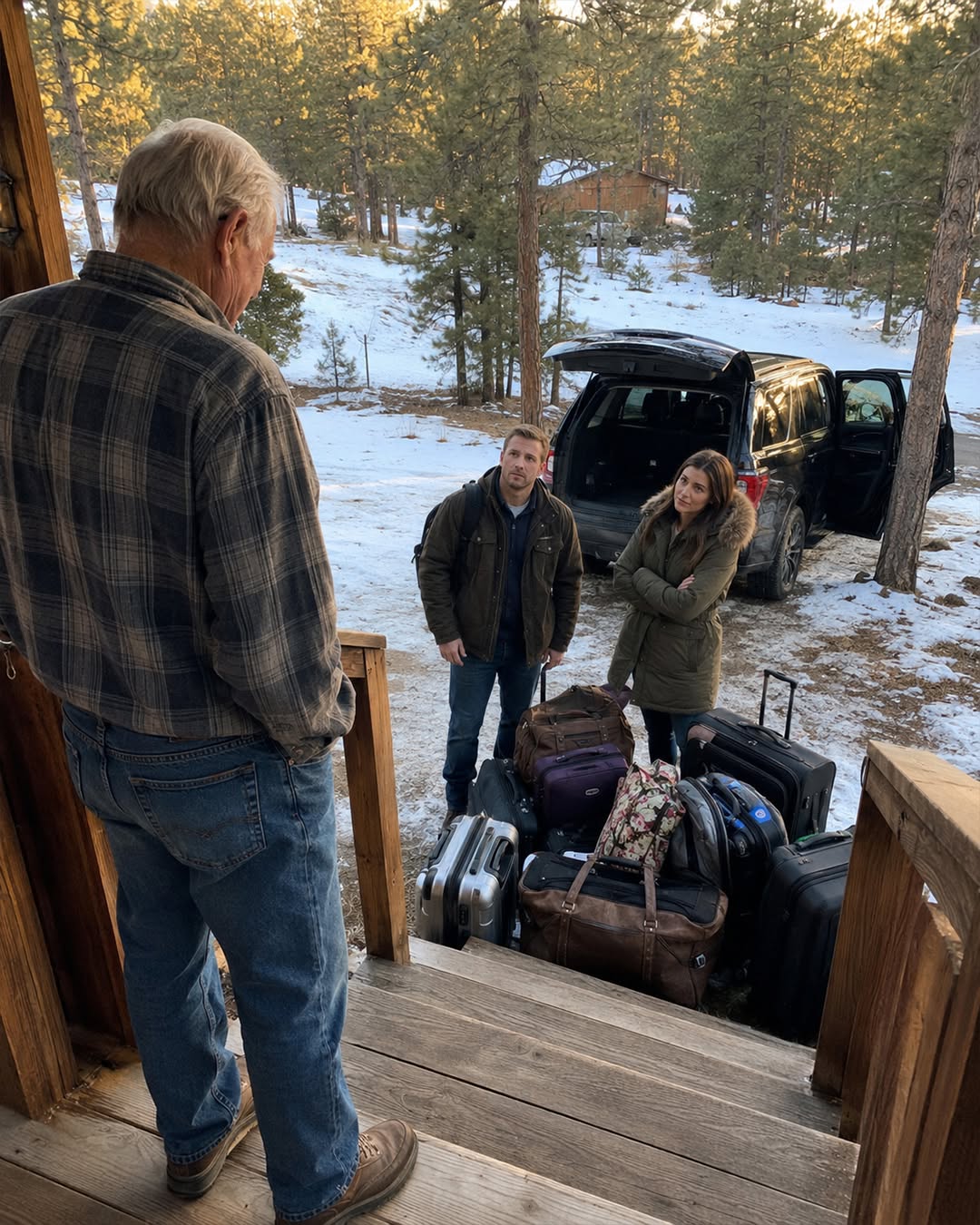
Ruth stepped in first, cheeks red from the cold, holding a casserole wrapped in two towels. She was seventy and moved like a woman who had never waited for permission from furniture or men. Luis followed with two students carrying tool bags. Ben came behind them with lumber balanced on one shoulder. A young mother named Claire arrived with her little boy, who immediately ran to the toy shelf and picked up a train. Two college girls from town brought boxes of donated books. Everyone greeted me as if my presence mattered because it did.
“Morning, Harold.”
“Coffee on?”
“Where do you want these boards?”
“I brought the screws you asked for.”
“Claire says the table size you sketched will fit her kitchen.”
Then they noticed Daniel and Melissa.
The room adjusted, not dramatically, but completely. Conversations softened. Eyes moved from the luggage by the doorway to Melissa’s polished boots to Daniel’s uncertain face. Ruth looked at me with one raised eyebrow, a silent question only a neighbor could ask.
I answered with a small nod.
“Everyone,” I said, “this is my son, Daniel, and his wife, Melissa. They stopped by for a visit.”
A visit.
Melissa heard it. Her chin lifted.
Ruth smiled politely. “Nice to meet you. Harold talks about Daniel.”
Daniel looked surprised. “He does?”
“Of course he does,” Ruth said, setting the casserole down. “You’re his son.”
The sentence landed hard.
Not because it was sentimental. Because it was simple. I had never erased Daniel from my life. I had not returned his neglect with neglect. He existed in my stories, my memories, my prayers, even when he had stopped showing up in my days.
Luis shook Daniel’s hand. “Your dad taught half my students more patience with a hand plane than I’ve managed in a classroom.”
Ben laughed. “He also taught me that my measuring is sloppy, which was rude but accurate.”
Claire stepped forward, holding her son’s mittened hand. “Harold built my boy a bed when we moved into our new apartment. Wouldn’t let me pay him. Said the payment was that I had to come back someday and help someone else.”
Melissa’s eyes moved around the room as each person spoke.
She had expected staff, perhaps. Or neighbors impressed by property. Instead, she found witnesses. People whose affection could not be explained by inheritance.
Daniel walked slowly back into the great room, as if seeing it differently now. The bins were not clutter. They were systems. The benches were not a sign of poverty. They were purpose. The long table was not unfinished decor. It was where people gathered to become useful.
Ruth tugged off her gloves. “Harold, did the foundation papers come?”
“In the blue binder.”
Melissa turned sharply. “Foundation papers?”
I took the binder from the island and placed it on the table.
Daniel stared at it. “Dad?”
I opened the cover.
Inside were documents, receipts, schedules, letters, photographs, and the formal paperwork I had signed two months earlier with a small local attorney who worked above the bookstore on Main Street. The attorney had said I could keep things simple. I had said simple was fine as long as it was clear.
Melissa stepped closer despite herself.
On the first page was the name.
MARGARET’S TABLE COMMUNITY WORKSHOP
Below it was a copy of the deed transfer arrangement, the operating agreement, the cabin use plan, and the donation ledger. The cabin was mine to live in for the rest of my life. After that, it would not pass quietly into family hands or become a listing with staged photographs and inflated expectations. It would remain what it had become: a place where people built what others needed.
Daniel read the first page slowly.
Melissa read faster.
SEE NEXT PAGE >>>
To see the full cooking instructions, go to the next page or click the Open button (>) and don't forget to SHARE it with your friends on Facebook.